 Posted by
 by: Alayna Bolda
Editor: Yanxi Zhou
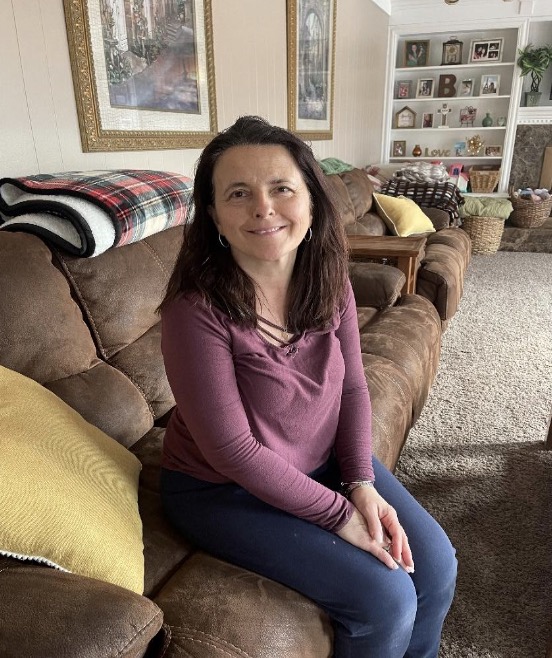
Pashka Gegaj poses in the living room of her home in March of 2022. She first migrated to the United States when she was 13, and her family was given the opportunity to escape from their communist country and start a new life. She learned to work through her language barrier, as well as juggling school and work. She now has a license in childcare as she devotes her life to nurturing and caring for younger children.
Here, we ask her about her journey and how she got to where she is now.
Q: Describe the place where you grew up. What was your life like there?
A: I was born in Montenegro, formally known as Yugoslavia. I lived on top of a mountain ridge in a stone shack no bigger than 20×25 square feet. You couldn’t reach my house by car; the roads were too narrow, so we had donkeys to take us up. It was a simple life; we had no heat or electricity, and a majority of our food came from livestock. We didn’t even have bathrooms but rather a small hole outside our house. There were roughly 20 people under one roof because we had shared a home with many of our uncles and cousins at the time. But we were never unhappy because that is all we knew.
Q: Why and how did you leave? Where did you go?
A: We left in October of 1970. We were poorer than poor, and our country was being overrun by communism. Our leader, Josip Tito, was a greedy man and sent Montenegro into Economic disparity, making it difficult for us to stay afloat. We needed a way out, and our church at the time was part of an organization that helped give people like us an opportunity to escape this life. They ended up sponsoring us, giving us a one-way ticket to freedom.
Q: How did you feel when you left? Did you bring anything of value with you?
A: We didn’t have much, pretty much just the clothes on our backs is all we brought with us and maybe some jewelry that was given to us as a parting gift. I had my parents and two sisters, and that’s all we needed. I was excited to embark on this new journey because suddenly, so many new opportunities had opened up that I didn’t have before.
Q: How hard was it adjusting to this new lifestyle in a foreign country?
A: Language was the biggest barrier. My parents spoke little to no English, but because I was younger, me and my sisters picked it up quickly. Although me being the oldest, it was on my shoulders to go to work as well as take care of my siblings. It was difficult for me and my parents to find work because, at the time, many were discriminatory against us being immigrants, but we worked hard nonetheless. We lived in a small apartment in downtown Hamtramck and barely scraped by to pay rent every month, but we were fortunate for this newfound opportunity.
Q: What made you want to pursue the path you are on at this point?
A: Once I graduated high school, I paid my way through college. I graduated with an associate degree in early childhood from Macomb Community College. I developed a love for taking care of children at a young age as I pretty much raised my younger siblings. I have been through a lot, and because of this, I am forever grateful for all that I have. I try to give back each and every day through my work. When I take on a new child and see that look of fear in their eyes of this foreign environment, I can’t help but feel for them, and it is then that I take them in my arms and try and show them the way as well as teach them right from wrong. I can only hope that the little acts that I take will help guide them in some way down the line.
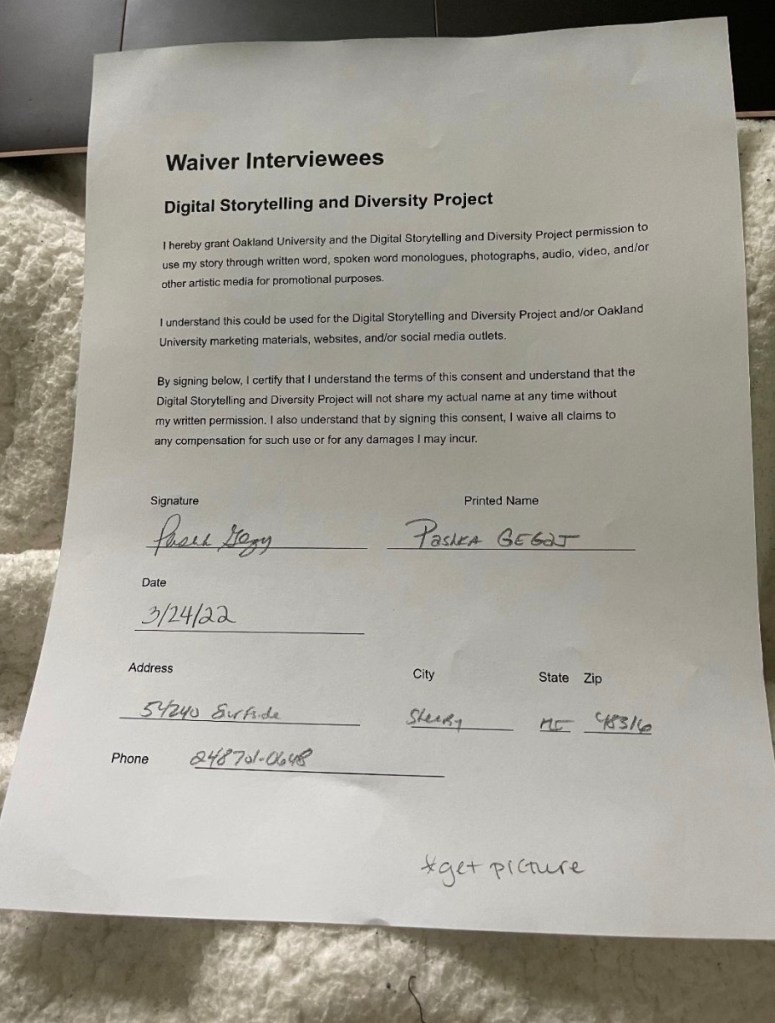
*I don’t want my work to be seen for the digital storytelling project, so I chose not to incorporate the other form. Thank you.
 StorytellingDiversity